
How can I write content efficiently with ChatGPT?

In a nutshell…
My transition to using ChatGPT for copywriting has been a rewarding adventure, punctuated by challenges and successes:
- Workflow transformation: ChatGPT, which should be considered as an assistant, has significantly improved my workflow, despite some initial challenges related to the amount of content produced, style, and AI detection.
- Adjustments and customization: I’ve adapted my working method, giving it a more precise style and exploiting the features of the paid version for more advanced customization.
- Conclusive results: With perseverance, I was able to produce content that accurately reflected my voice while respecting Google’s recommendations.
This experience enabled me to optimize my content production and take full advantage of ChatGPT’s capabilities.
Writing with ChatGPT is no panacea…
By writing content with ChatGPT (version 4) to assist me, I ended up becoming fast and efficient. But I’m far from asking it to generate an article for me from a simple query. I’ve put a lot of work into developing a satisfactory methodology for writing with ChatGPT.
In short, ChatGPT has become my assistant. And it’s as an assistant that it should be considered.
All the same, it transformed my way of working.
My experience with AI: from disappointment to disappointment…
It started with a lot of hope. Like just about everyone else, I thought AI would be a miracle solution.
Insufficient quantity
So I started by asking ChatGPT to write complete articles, but my first disappointment was that there weren’t enough of them. Statistics show that longer articles are statistically more popular than shorter ones.
So I changed tactics. I asked ChatGPT to provide me with a detailed plan and then to write each section separately. I solved my quantity problem, and thought that was the end of it. Far from it!
Tone and style completely off
Then I noticed that the tone and style were not at all what I was looking for. It was light years ahead of my style and very recognizable as AI-generated content. So I thought I’d have to come up with some techniques. Refine the style by doing some prompt engineering, try out other AIs and writing tools.
The result improved, but I was already a long way from the initial dream of giving it a query with a subject and retrieving the ready-made article.
AI detectors
Then I discovered the existence of AI-generated text detectors. I was shocked by the fact that almost everything I produced was detected as having a probability of being between 95 and 100% AI!
This led me to think that Google might also detect my content as inauthentic, which not only compounded my disappointment, but also called into question the whole value of copywriting.
So I tried using other AI technologies in the hope of “humanizing” my content. However, I soon realized that my efforts were in vain.
The very idea of using AI to counter AI seemed perverse to me.
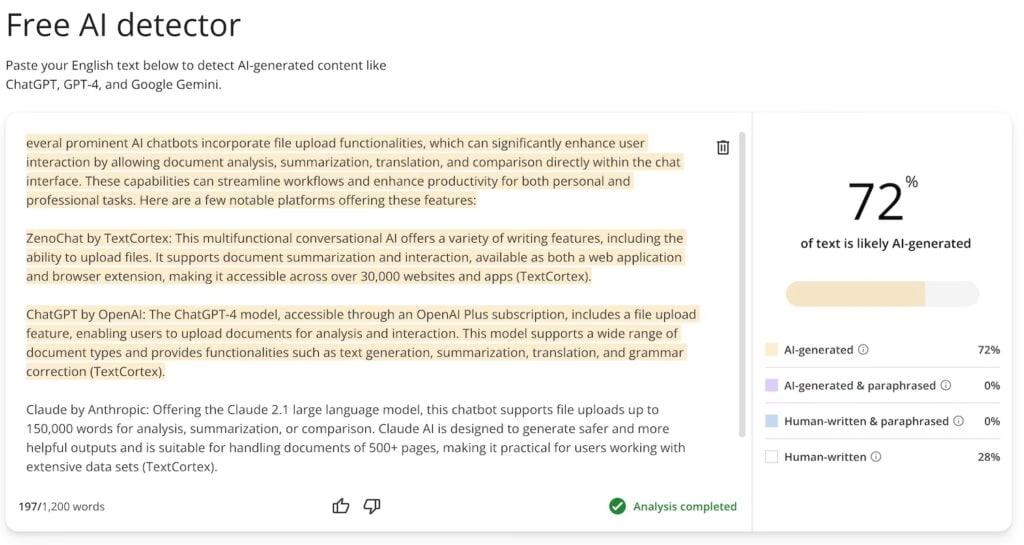
Here are the ones I used:
- Quilbot – 1200 free words
- ZeroGPT – 15000 free characters – unstable results in recent days
- Originality.ai – 50 free trial credits (too few)
- Scribbr – 500 words max
Note that the percentage (e.g. 72%) given by the detectors does not mean that the text would be 72% written by the AI, but that the probability of it being written by the AI is 72%.
Back to first principles
Writing content with ChatGPT is not at all what I expected. In the end, it was back to basics.
In fact, (re)discovering Google’s recommendations was a real liberation for me. In this context,AI threatens to supplant Google search. And given the technological arsenal available to SEO manipulators, the quality of search results has deteriorated. Google has therefore had to refine its detection mechanisms.
In fact, for those of us who want to preserve the authenticity of our work, it’s a godsend! We no longer need to play the dangerous game of trying to “beat Google”.
How can I get good results writing with ChatGPT?
My instructions to ChatGPT for tone and style
- Opt for short sentences, favouring the use of periods and line breaks.
- Use an active rather than passive style to give the text more dynamism.
- Avoid long introductions that unnecessarily weigh down the text and try to give it importance.
- Don’t use metaphors, embellishments or overly sophisticated, literary terms that detract from the main message.
- Do not use adjectives or adverbs unless they are necessary for understanding.
- Be direct, with a concise, to-the-point style.
- Use first-person sentences.
- Use the present tense.
Adjustments are always necessary
That said, my experience has shown me that even with these adjustments, writing with ChatGPT never achieves perfection on the first try. Adjustments are an integral part of my process.
I start by copying and pasting the generated text, then I rework it. I often reword it. I often delete sentences, shorten others, or merge them when necessary.
That said, it’s an exceptional time-saver.
Tip: get the paid version
I strongly advise you to purchase theChatGPT Plus monthly subscription.
In addition to being much less limited by the number of queries, it lets you create custom GPTs to which you give global directives in the form of text or documents.
As a result, instead of having to repeat instructions every time in terms of style and overall information about you and the objective of your conversation, everything is memorized. This doesn’t mean you can’t make adjustments as you go along, as I said, but it’s a huge time-saver. You can also adjust the global configuration of the GPT itself when necessary.
Personally, I find the help and time ChatGPT saves me, and not just in terms of the writing itself, far more valuable than $20 a month.
Conclusion: laborious but convincing
My revised copywriting process with ChatGPT proved extremely effective!
This is still the style that suits me, and I invite you to find your own. Take your time, it’s worth the effort.
It has saved me time on several levels: research, organization and actual writing. Thanks to this method, I can produce several articles in the time it would take me to write just one. I often even do it in parallel, with AI giving me ideas during the process, or I see that I have a lot of content that could make 2 or 3 articles.
Finally – and this is a significant victory – my content is often detected by AI detectors as being virtually 100% human. This not only means that I manage to maintain authenticity and personality in my writing, but also to meet Google‘s requirements and recommendations in terms of useful content and E-E-A-T.
I feel that the content reflects my voice, my ideas, and my style, thanks to ChatGPT, who has been a good assistant, not a replacement for me. Plus, it’s fun! It makes you feel less alone 😊
Tell me what you think of this methodology. I’d be delighted to discuss it and learn about your methods.
Frequently asked questions
What’s the best way to use ChatGPT for content writing?
Experience has shown that using ChatGPT as an assistant, rather than a replacement for full article writing, is most beneficial. This involves working interactively with the tool to generate detailed outlines and write sections individually, to optimize content quantity and quality.
How can I adjust the style and tone of the content generated by ChatGPT?
It’s essential to fine-tune the style and tone of the content generated by ChatGPT to match your unique voice. This can involve prompt engineering, using specific guidelines for tone, style, and structure, as well as manual revisions to fine-tune the text produced.
How do you deal with AI-generated content detectors?
In the face of detection by specialized tools, adopting a hybrid approach to using ChatGPT, combined with substantial manual adjustments to the content generated, can help maintain authenticity and reduce the chances of being flagged as non-human content.
What are the advantages of a paid subscription to ChatGPT Plus for editors?
Paid subscription to ChatGPT Plus offers significant benefits, such as fewer restrictions on the number of queries and the ability to create custom templates, saving time and improving the overall efficiency of the copywriting process.